
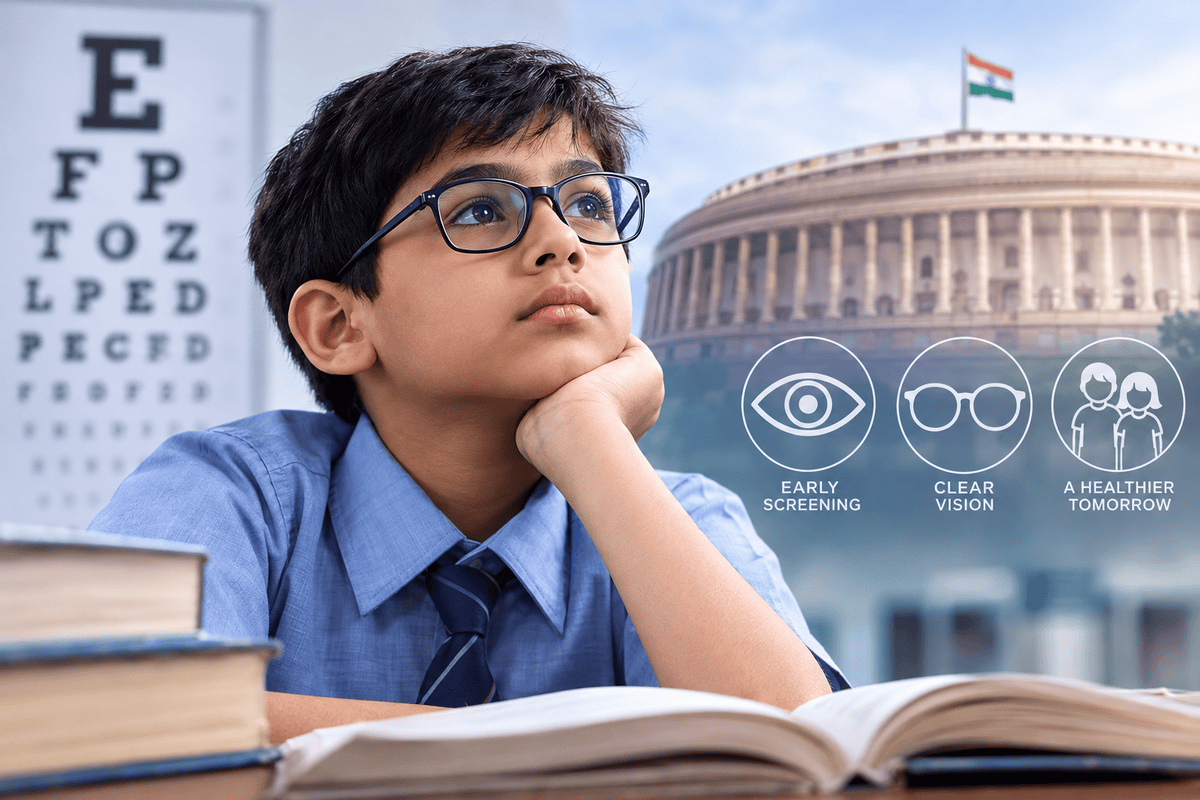
Childhood myopia has finally received attention at one of the country’s highest policymaking forums. On 12 August 2026, Dr Jashvantsinh Salamsinh Parmar, Member of Parliament from Gujarat, raised in the Rajya Sabha the growing burden of myopia among children in India and called for a coordinated national response.
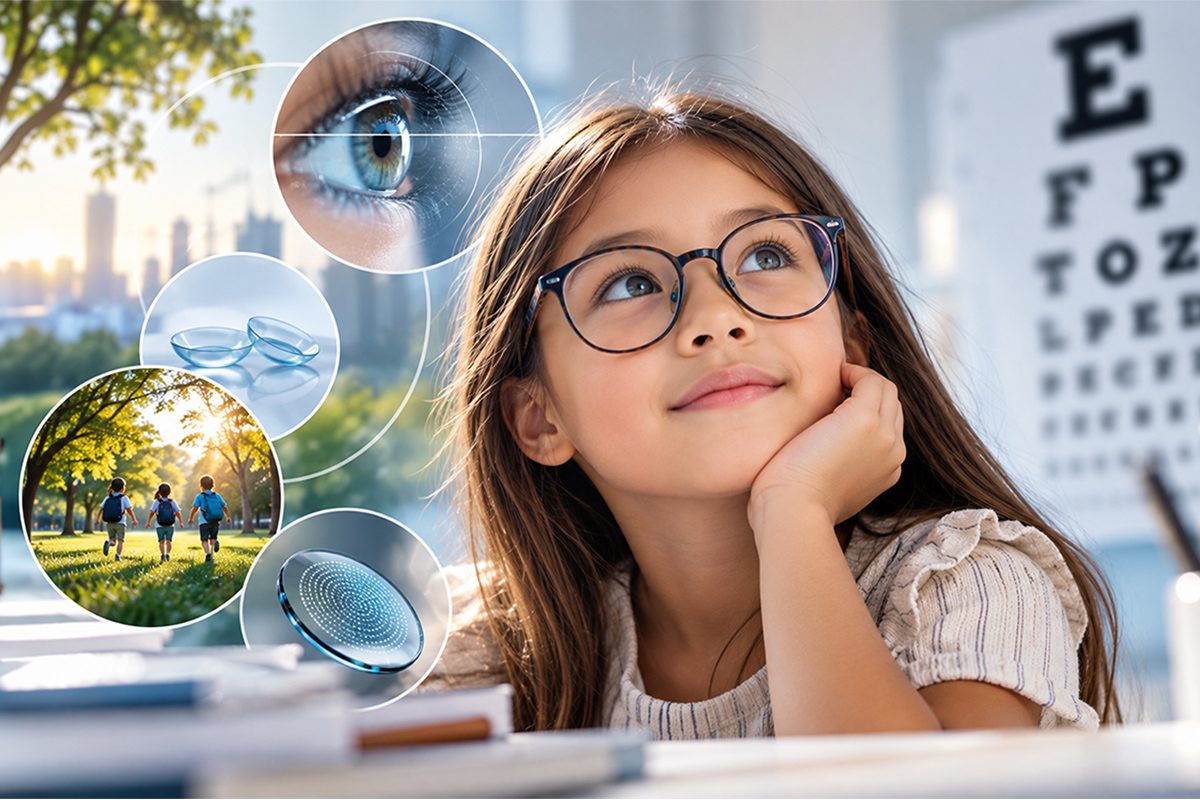
For those of us associated with vision care, this is a welcome and timely development. Myopia is no longer simply a question of prescribing spectacles so that a child can see the blackboard clearly. Increasingly, it needs to be viewed as a public-health issue requiring prevention, early detection, appropriate correction, management of progression and long-term follow-up.
A Growing Public-Health Challenge
Dr Parmar drew attention to several factors associated with the increase in childhood myopia, including reduced outdoor activity, intensive near work and prolonged use of digital devices. Changes in children’s lifestyles, particularly following the expansion of online education during the pandemic years, have added urgency to this discussion.
Globally, projections suggest that close to half of the world’s population could be myopic by 2050. More importantly, a significant proportion could develop high myopia.
This distinction matters. While myopia can generally be corrected effectively with spectacles or contact lenses, progressive and high myopia can increase the lifetime risk of serious ocular complications, including retinal problems, glaucoma and myopic maculopathy.
India therefore has an opportunity to act before childhood myopia develops into a substantially larger eye-health burden.
From Correction to Prevention and Control
One of the important aspects of the intervention in Parliament was the call for a National Childhood Myopia Prevention and Control Programme.
Among the measures proposed were annual vision screening of schoolchildren, integration with existing school-health initiatives, national clinical guidance, affordable access to spectacles and appropriate myopia-control interventions, surveillance and research, and greater awareness among parents and teachers.
These proposals deserve serious consideration.
India already has considerable experience in school eye screening. However, identifying a refractive error and providing spectacles should increasingly be regarded as the beginning of the process rather than its conclusion.
A child diagnosed with myopia needs appropriate refraction and correction. Where myopia is progressing, the child should also have access to qualified eye-care professionals who can assess progression, advise the family and consider evidence-based management options where clinically appropriate.
Regular follow-up is equally important.
Outdoor Time Must Become Part of the Conversation
Technology is now an integral part of children’s education and everyday lives. It would therefore be unrealistic to frame the solution simply as eliminating screens.
The discussion needs to be broader.
Parents, schools and children should understand the importance of balancing prolonged near work with appropriate breaks and, importantly, encouraging adequate outdoor activity. Schools can play a major role by incorporating eye-health awareness and healthy visual behaviour into their overall health programmes.
Public messaging should remain simple and evidence-based rather than creating unnecessary anxiety around digital devices.
Access and Affordability Are Critical
Any national strategy must recognise India’s enormous diversity.
Children in metropolitan areas may have relatively easy access to ophthalmologists, optometrists and optical outlets. The situation can be very different in smaller towns and rural communities, where both access and awareness continue to be challenges.
A successful programme will therefore require an integrated eye-care ecosystem involving ophthalmologists, optometrists, opticians, vision technicians, hospitals, NGOs, schools, government agencies and the optical industry.
Spectacles remain among the simplest and most cost-effective assistive products available. No child should be disadvantaged in education merely because an uncorrected refractive error has not been detected or because the family cannot afford appropriate spectacles.
At the same time, the affordability conversation must increasingly extend to children whose myopia is progressing and who may require continued professional management.
An Opportunity for the Optical Industry — With Responsibility
The parliamentary discussion also has important implications for India’s optical industry.
The growing prevalence of childhood myopia will inevitably increase demand for children’s eyewear, better lenses and myopia-management solutions. Several technologies are now available or emerging globally, including specially designed spectacle lenses and contact-lens approaches intended to slow myopia progression.
But this should not be viewed merely as a commercial opportunity.
Industry has an important responsibility to support professional education, clinical evidence, affordability and public awareness. Claims relating to myopia control must be scientifically substantiated, clearly communicated and used within an appropriate professional-care framework.
The objective should be better long-term visual outcomes for children rather than simply selling a more sophisticated product.
Building a National Myopia Strategy
India does not necessarily have to create an entirely new healthcare infrastructure to address childhood myopia. Much can be achieved by strengthening and connecting programmes, institutions and capabilities that already exist.
The country has globally recognised eye-care institutions and organisations that have demonstrated scalable models of service delivery, training and community eye care. Institutions such as Aravind Eye Care System, LV Prasad Eye Institute, Sankara Nethralaya, Sankara Eye Foundation and Dr Shroff’s Charity Eye Hospital have accumulated considerable experience that can contribute to such an initiative.
Importantly, organisations such as VISION 2020: The Right to Sight – India, with its extensive network across the eye-care sector, and internationally recognised training institutions such as the Lions Aravind Institute of Community Ophthalmology (LAICO), with its expertise in capacity building and developing sustainable models for delivering eye care to large and underserved populations, can be effectively leveraged as part of a national strategy.
Their experience in professional training, capacity building, community outreach and scalable eye-care delivery could help translate policy objectives into programmes that reach children across urban, rural and underserved communities.
Private-sector eye hospitals, practitioners, NGOs and the optical industry can similarly complement these efforts, creating a truly collaborative national response.
School-health programmes can incorporate systematic vision assessment. Referral pathways can connect children requiring further examination with trained eye-care professionals. Digital systems can help track children identified with myopia and encourage periodic follow-up
Myopia prevalence varies considerably between urban and rural populations and across age groups. A national surveillance mechanism would allow policymakers to understand not only prevalence but also incidence, age of onset and progression.
Such information will be essential for designing interventions appropriate to Indian conditions rather than simply adopting models developed elsewhere.
A Perspective
Having spent several decades associated with the optical and vision-care sector, I believe the significance of this parliamentary intervention goes beyond the individual recommendations made.
It represents an important change in the conversation—from simply correcting myopia to preventing its onset where possible, detecting it early and managing its progression.
India has successfully addressed major public-health challenges when government, healthcare professionals, industry and civil society have worked together. Childhood myopia deserves a similar collaborative approach.
The immediate priorities should be clear: screen children early; ensure that every child who needs spectacles receives them; encourage healthy visual behaviour and outdoor activity; identify progressing myopia; establish appropriate referral and follow-up protocols; and make evidence-based myopia-management options accessible and affordable.
The intervention by Dr Parmar in the Rajya Sabha should therefore be seen not merely as another parliamentary discussion, but as an opportunity to initiate a broader national conversation—and, ultimately, coordinated action.
With childhood myopia now reaching Parliament, there is an opportunity to convert this discussion into a structured national initiative. India already possesses much of the professional expertise, institutional capacity and community eye-care experience required. What is needed is to bring these strengths together under a coordinated strategy.
The objective is straightforward:
Every child should have the opportunity to see clearly today, while we do everything scientifically possible to protect that child’s vision for tomorrow.
The above views expressed by Ramachandran Parthasarathy are in his personal capacity as Eye Wear Consultant and Fellow -Institute of Directors.
 Ramachandran Parthasarathy
Eyewear Consultant
Eyewear Business Strategy Expert South Asia
Honorary Advisor – India Vision Institute