



AI Transforms Myopia Care
AI is already transforming various facets of eye care, but in the case of myopia, its potential is uniquely powerful
Myopia is no longer just a common vision concern; it’s becoming a global epidemic. By 2050, it is estimated that half of the world’s population will be myopic, with a significant portion developing high myopia, leading to sight-threatening complications. While traditional management strategies have focused primarily on diagnosis and optical correction, a new player is entering the field: Artificial Intelligence (AI).
From early detection and progression prediction to personalised treatment plans, AI is making myopia management smarter, faster, and far more proactive.
Early Detection at Scale
The fight against myopia begins with early detection, and AI is proving to be a game-changer here.
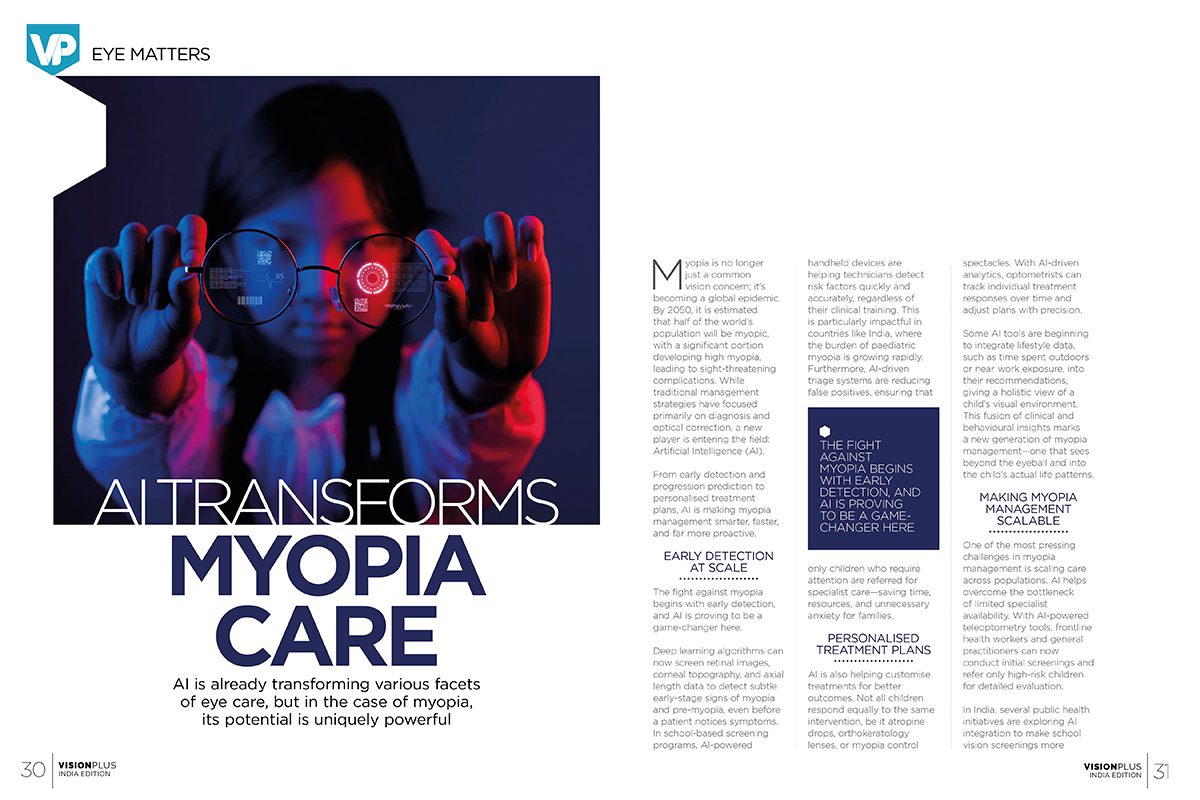
Deep learning algorithms can now screen retinal images, corneal topography, and axial length data to detect subtle early-stage signs of myopia and pre-myopia, even before a patient notices symptoms. In school-based screening programs, AI-powered handheld devices are helping technicians detect risk factors quickly and accurately, regardless of their clinical training. This is particularly impactful in countries like India, where the burden of paediatric myopia is growing rapidly. Furthermore, AI-driven triage systems are reducing false positives, ensuring that only children who require attention are referred for specialist care—saving time, resources, and unnecessary anxiety for families.
 Personalised Treatment Plans
AI is also helping customise treatments for better outcomes. Not all children respond equally to the same intervention, be it atropine drops, orthokeratology lenses, or myopia control spectacles. With AI-driven analytics, optometrists can track individual treatment responses over time and adjust plans with precision.
Some AI tools are beginning to integrate lifestyle data, such as time spent outdoors or near work exposure, into their recommendations, giving a holistic view of a child’s visual environment. This fusion of clinical and behavioural insights marks a new generation of myopia management—one that sees beyond the eyeball and into the child’s actual life patterns.
Making Myopia Management Scalable
One of the most pressing challenges in myopia management is scaling care across populations. AI helps overcome the bottleneck of limited specialist availability. With AI-powered teleoptometry tools, frontline health workers and general practitioners can now conduct initial screenings and refer only high-risk children for detailed evaluation.
In India, several public health initiatives are exploring AI integration to make school vision screenings more efficient and consistent. In private practice, AI allows practitioners to expand their reach while maintaining high-quality care. AI-enabled patient portals, automated reminders, and home-based monitoring tools are also improving compliance—one of the biggest hurdles in long-term myopia control.
Challenges And Responsibilities
As with any technological advancement, the use of AI in myopia management comes with its own set of concerns. Data privacy, algorithm transparency, and clinical validation are all critical to ensure ethical use. Importantly, AI should always support, not replace, clinical judgment.
Practitioners must also stay informed and trained. Using AI effectively requires understanding how it works, what it can (and can’t) do, and how to communicate its role to concerned parents. Investment in AI should be matched by investment in professional development to ensure that technology adoption is meaningful rather than superficial.
AI will not solve the myopia crisis on its own. But it equips us with sharper tools, deeper insights, and a more scalable approach to prevention and control. For optometrists, embracing AI doesn’t mean surrendering clinical skill; it means enhancing it.
As AI continues to evolve, its integration into everyday clinical workflows will only deepen.
Emerging systems are beginning to combine genetic profiling, environmental mapping, and long-term biometric tracking to offer highly accurate, child-specific risk assessments.
This level of precision empowers practitioners to intervene earlier and more effectively than ever before. Moreover, as costs decrease and accessibility grows, even smaller practices will be able to adopt AI tools, levelling the playing field across urban and rural settings.
Ultimately, AI’s greatest contribution may be its ability to unify data, insight, and action—helping the eye care community can collectively slow the global rise of myopia.
The future of myopia care is intelligent, individualised, and increasingly data-driven. And with AI by our side, we’re better prepared to slow down this growing epidemic.
Predicting Progression, Not Just Monitoring It
One of AI’s most valuable contributions to myopia management is its ability to predict how a child’s myopia will progress over time. Traditional monitoring requires multiple visits and depends heavily on practitioner interpretation. AI, however, can process vast datasets, including age, genetics, lifestyle factors, and biometric trends, to provide predictive models with remarkable accuracy.
For instance, platforms like Myopia Master and Treehouse Eyes are leveraging AI algorithms to help optometrists forecast future axial elongation and refractive error changes. This allows practitioners to move from reactive treatment to proactive management.