
There are evenings that belong to cinema, and then there are evenings where style quietly rewrites the narrative. The 98th Academy Awards, held on 15 March 2026 at the Dolby Theatre, did both with remarkable ease.
As Conan O’Brien returned to host the ceremony, the evening unfolded with all the expected grandeur. Films from across 31 countries were honoured, a new category for Best Casting made its debut, and the industry gathered to celebrate its finest work. Michael B. Jordan took home Best Actor for Sinners, while Jessie Buckley claimed Best Actress in a Leading Role.
Yet, long before the winners were announced, the red carpet had already offered something equally compelling. This year, the most striking detail was not just the tailoring or the jewellery. It was eyewear.
The Rise of Eyewear as Intent
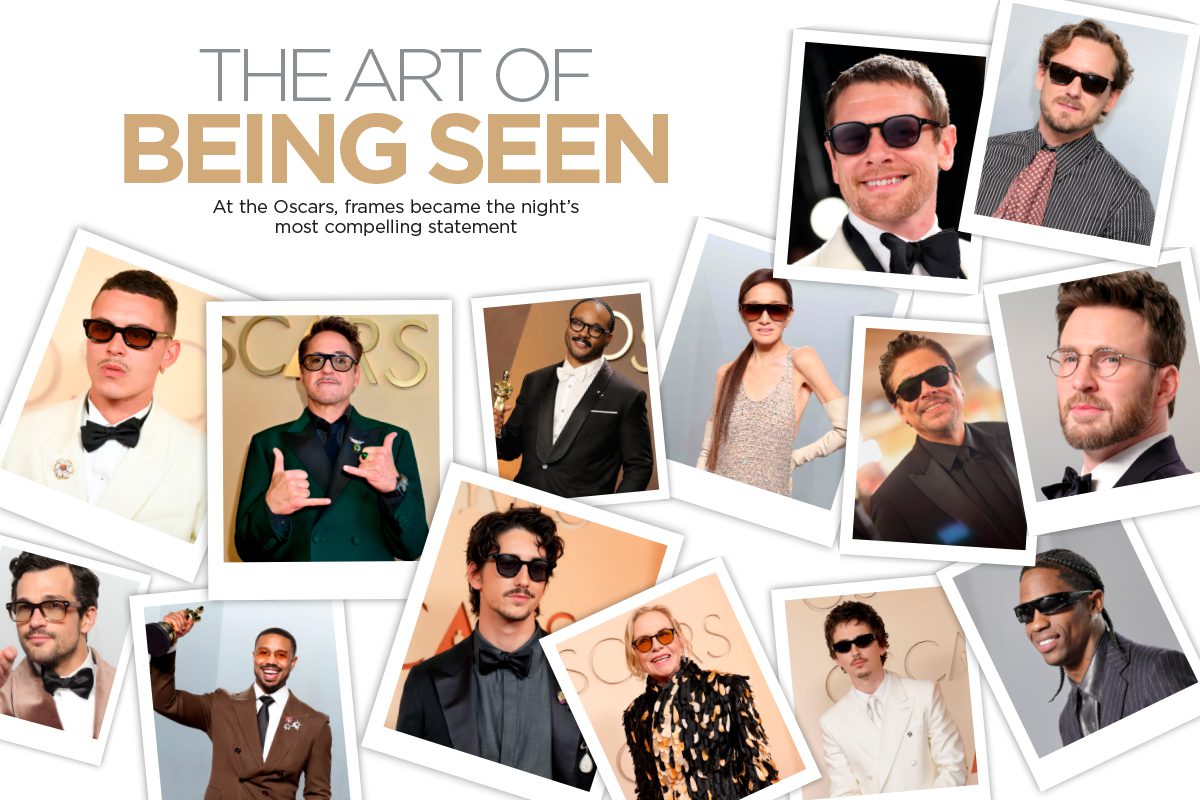
What stood out immediately was a sense of clarity in styling. White tailoring dominated the carpet, crisp and cinematic, almost like a deliberate canvas. Against this, eyewear became the defining contrast. Dark lenses, sculptural frames and tinted optics introduced depth, turning classic looks into something more expressive.
Eyewear was not used to complete an outfit. It was used to define it.
Michael B. Jordan demonstrated this with precision. His Oliver Peoples TK 13 rimless sunglasses, fitted with soft orange-tinted lenses, felt considered rather than decorative. The tint caught the light gently, adding warmth without distraction. It was a restrained choice, but one that carried presence.
In contrast, Amy Madigan brought a sense of playfulness through her Garrett Leight Clune sunglasses with yellow lenses. Set against her Dior ensemble, the colour felt deliberate and full of character. It was not simply about coordination. It was about expression.
Icons Who Understand Restraint
There is a certain confidence in choosing not to overstate, and few understand this better than Robert Downey Jr. Presenting alongside Chris Evans, he wore Oliver Peoples Estin frames in black, adapted with light green prescription lenses.
It was a subtle shift, but one that made all the difference. The tint softened the frame and caught the light in a way that felt intentional yet effortless. It is this kind of detail that separates styling from instinct.
Benicio del Toro took a different route, leaning into drama with visor-style sunglasses from the Oliver Peoples collaboration with the Paul Newman Foundation. The teardrop shape carried a sense of nostalgia, yet the execution felt current. It was a reminder that referencing the past can still feel entirely modern when done with clarity.
Director Ryan Coogler continued his now familiar association with Matsuda M1038 opticals. Worn throughout the awards season, the frames have become part of his visual identity. There is something compelling about that kind of consistency, about allowing a single piece to define your presence over time.
Where Personality Took Shape
The variety of eyewear this year created a visual rhythm across the carpet. No two choices felt the same, yet none felt out of place.
Spike Lee, known for his unapologetic individuality, arrived in white Oakley Meta HSTN smart glasses. Combining technology with personal style, the frames felt forward-looking without losing character.
Joel Edgerton opted for Tom Ford Penn 02 sunglasses with light grey blue lenses that subtly echoed his natural features. Chris Evans chose gold Garrett Leight Wells J frames with green lenses, adding a distinctive edge to his look.
One of the most memorable appearances came from Jack O’Connell, who arrived with fangs as a nod to his role in Sinners. Paired with Dunhill sunglasses featuring green lenses and gold stud detailing, the look carried a sense of theatre without losing its style credibility.
Younger actors brought their own perspective. Milo Manheim kept things clean with Garrett Leight Broadway frames and dark grey lenses, while Timothée Chalamet leaned into his signature aesthetic with Chrome Hearts Edenbox sunglasses, dark and sculptural.
Elsewhere, Bobby Cannavale introduced depth with bourbon red Jacques Marie Mage Vendome frames, and Arón Piper balanced a white suit with sharply defined Jacques Marie Mage Whiskeyclone designs. Each choice felt personal, each frame a reflection of its wearer.
After Hours, After Rules
As the ceremony concluded, the Vanity Fair after-party offered a different mood. The sense of restraint gave way to experimentation, and eyewear became even more expressive.
Travis Scott arrived in Oakley Highland wraparound sunglasses with Prizm Black lenses, futuristic and bold. Lewis Pullman played with pattern and proportion, his Saint Laurent sunglasses grounding the look.
Vera Wang once again demonstrated her affinity for dramatic silhouettes with an Alaïa visor. Sleek and architectural, it blurred the line between accessory and design.
Usher embraced oversized metal Jacques Marie Mage frames, pairing them with a monochromatic look and diamond accents that felt both polished and effortless.
Even in quieter moments, there was intention. Paul Anthony Kelly was seen in what appeared to be Brunello Cucinelli sunglasses, square in shape with photochromic lenses that shift with changing light. It was a subtle choice, but one rooted in practicality and refinement.
What made this year stand apart was not simply the presence of eyewear, but the way it was used.
These were not afterthoughts added at the last minute. They were considered decisions, chosen with the same care as tailoring or fabric.
Eyewear revealed personality. It introduced contrast. It carried a narrative. Whether through a soft tint, a bold visor or a classic frame reimagined, each choice added depth to the overall look.
For those who observe fashion closely, the message was clear. Eyewear has moved far beyond function. It has become one of the most powerful tools of self-expression in modern style.
As another awards season comes to a close, one detail remains impossible to overlook. Among the gowns, the precision tailoring, and the cinematic achievements, it was the frames that held our attention the longest.
Daniela D’Souza