
In a significant milestone for Indian optometry and vision science, an indigenous innovation in optical lens technology has been granted a patent by the Indian Patent Office. The invention, titled “An optical lens with dual-band selective light attenuation” (Patent No. 587746), represents a meaningful advancement in managing photophobia and light-sensitivity-related conditions.
The patent has been awarded to Sleepaxa Private Limited, led by Optometrist, Founder & Head of Research and Development, Suraj D, marking what is believed to be the first Indian patent in the dual-band photobiological eyewear category.
Abstract
Background: Photophobia is the second most disabling symptom of migraine and a frequent presenting complaint across post-concussion syndrome, blepharospasm, and chronic ocular pain. Conventional therapeutic eyewear — broad-spectrum tints, generic blue-light blockers, and imported FL-41 lenses — attenuate light non-selectively, often at the cost of visual clarity and natural colour perception.
Innovation: An indigenously developed optical lens has been granted Indian Patent No. 587746 for a dual-band selective light attenuation profile that simultaneously targets the 460–490 nm (short wavelength) and 585–600 nm (amber) bands implicated in intrinsically photosensitive retinal ganglion cell (ipRGC) and trigeminovascular activation, while preserving the 520–560 nm photopic comfort window.
Significance: This is, to the authors’ knowledge, the first Indian patent in the dual-band photobiological eyewear category. The lens — commercialised as NeuroCalm FLX+™ — has been independently verified to meet ANSI Z80.3:2018, EN ISO 12312-1:2013, and AS/NZS 1067.1:2016 standards, with 100% UV protection.
1. Addressing a Daily Clinical Challenge
Photophobia is among the most common yet underserved complaints in optometric and neuro-ophthalmic practice. From the migraine patient who flinches under fluorescent corridors to the post-concussion adolescent who cannot tolerate a phone screen, light sensitivity is rarely an isolated symptom — it is a daily limitation on work, study, and quality of life.
Practitioners have historically relied on three categories of optical management:
- Imported FL-41 rose-tinted lenses, predominantly attenuating around 480–520 nm.
- Generic blue-light-blocking lenses are often non-therapeutic and inconsistent in spectral profile.
- Broad-spectrum tinted lenses, which reduce overall luminance at the cost of colour fidelity and
acuity.
Each of these provides partial relief, but at a measurable trade-off: dimming, chromatic distortion, and reduced contrast — none of which are clinically desirable for patients who depend on screens, road signage, or accurate colour perception in their daily occupations.
2. The Science: ipRGCs and the Spectral Basis of Photophobia
Modern understanding of photophobia centres on the intrinsically photosensitive retinal ganglion cells (ipRGCs) — a small population of melanopsin-expressing retinal neurons that project, via the posterior thalamus, to cortical and trigeminal pain-processing pathways. Unlike rods and cones, ipRGCs are intrinsically photosensitive and remain active even in patients with rod–cone degeneration, which explains why blind migraineurs can still experience light-induced pain.
Three lines of recent evidence converge on the clinical rationale for spectrally targeted lens design:
2.1 Selective amplification of ipRGC signals in migraine
McAdams and colleagues (2020), in a Proceedings of the National Academy of Sciences study of sixty participants, demonstrated that interictal photophobia in migraine is not driven by a different weighting of cone–melanopsin inputs, but by a post-retinal amplification of ipRGC signals specifically for visual discomfort. Migraineurs and headache-free controls integrate cone and melanopsin signals identically; what differs is the central gain applied to the resulting ipRGC output.
2.2 Melanopsin hypersensitivity at threshold
Zele and colleagues (2021), in Cephalalgia, quantified photophobia thresholds across the melanopsin and cone luminance action spectra. Migraineurs demonstrated photophobia thresholds approximately 0.55 log units lower than controls, with melanopsin contributing roughly 1.5× more than cone luminance to the discomfort response. The authors explicitly recommended that artificial-lighting and lens strategies should be designed to limit melanopsin excitation while preserving photopic luminance — the precise design philosophy underlying dual-band attenuation.
2.3 ipRGC hypersensitivity and cortical spreading depression
More recently (2024), an experimental study published via the National Library of Medicine demonstrated that ipRGC hypersensitivity in migraine can directly facilitate cortical spreading depression (CSD) — the electrophysiological correlate of migraine aura. In a murine model, blue light at 486 nm reliably elicited ipRGC responses and triggered CSD, while red light at 560 nm did not. Critically, pharmacological inhibition of melanopsin with opsinamide suppressed CSD even under blue light exposure, providing a mechanistic link between short-wavelength ipRGC activation and migraine attack initiation.
2.4 The amber band: an under-recognised photobiological trigger
While the 460–490 nm short-wavelength band has dominated the photophobia literature, converging clinical and biophysical evidence implicates a second region of vulnerability around 585–600 nm — the spectral neighbourhood of the long-isoform melanopsin sensitivity peak and the wavelengths most commonly emitted by high-pressure sodium and warm-white LED sources. Cortez and colleagues, in their thin-film notch-filter trial published via PMC, observed that a meaningful subset of migraine patients preferred a 620 nm notch filter to a 480 nm one, and explicitly noted that a notch closer to 590 nm may be more effective — a hypothesis the present dual-band design directly addresses.
Clinical implication. A lens that attenuates only the 480 nm region addresses one-half of the photobiological problem. A lens that attenuates broadly dims the entire visual scene. A lens that selectively attenuates both the 460–490 nm and 585–600 nm bands, while preserving the 520–560 nm photopic centre, is theoretically the closest optical translation of current ipRGC neuroscience into a wearable therapeutic device.
3. The Dual-Band Selective Attenuation Approach
The patented optical profile (Patent No. 587746) departs from single-band tinting in two structurally
distinct ways.
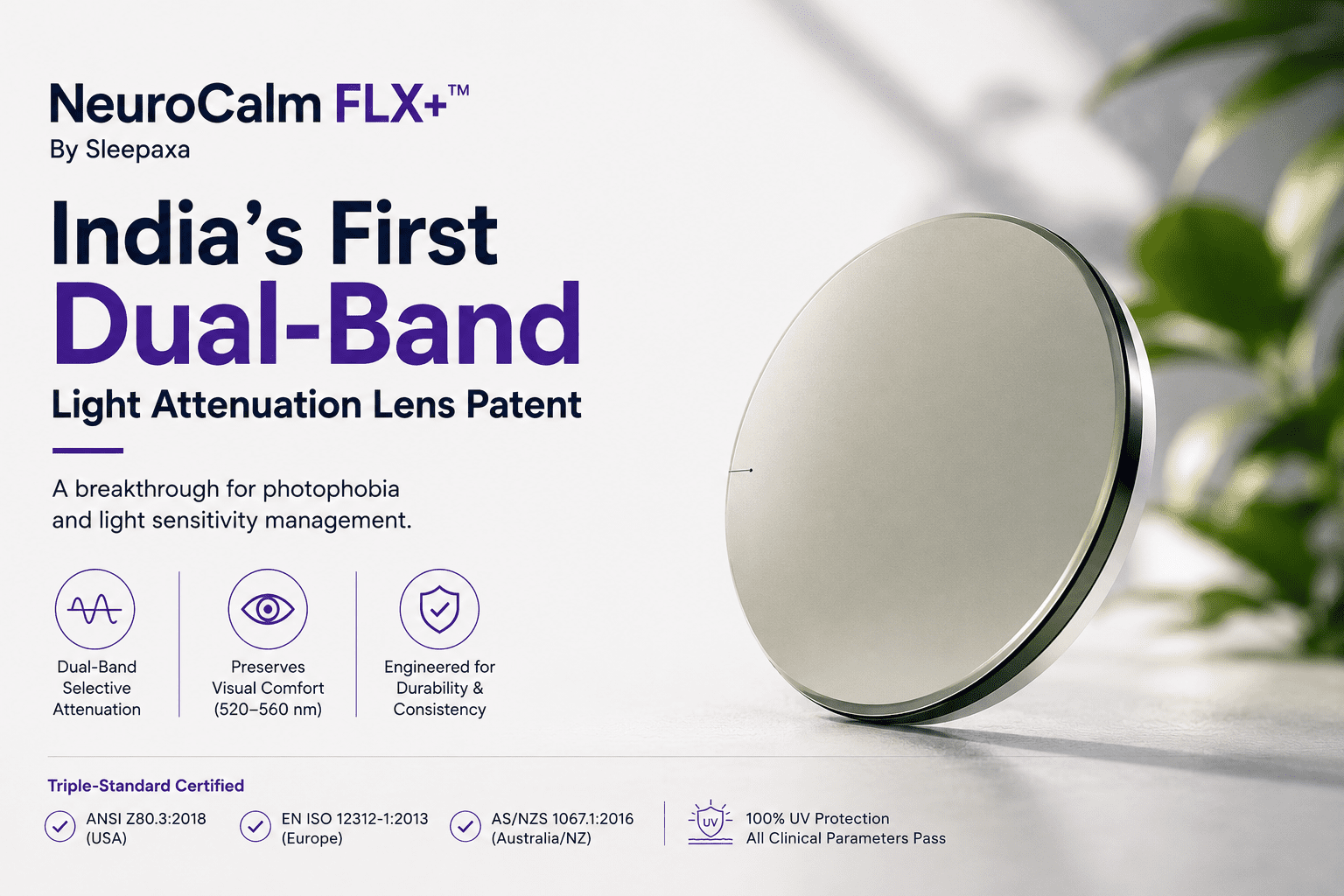
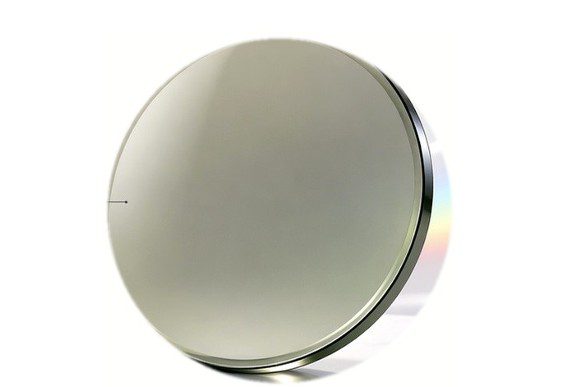 NeuroCalm FLX+™ spectral lens (uncut blank)
The lens carries a deliberately subtle, neutral grey-green appearance — the optical signature of dual-band (460–490 nm and 585–600 nm) selective attenuation with a preserved 520–560 nm photopic transmission window.
3.1 Dual-band attenuation, not single-band
The lens selectively attenuates two clinically defined spectral regions:
- 460–490 nm — the short-wavelength band of peak melanopsin sensitivity and primary ipRGC activation.
- 585–600 nm — the amber band associated with secondary photobiological discomfort, particularly under sodium-vapour and warm-LED lighting.
This dual-band profile addresses two independent photophobic triggers in a single optical device, without resorting to broadband dimming.
3.2 Preservation of the 520–560 nm photopic comfort window
Unlike conventional tints that uniformly reduce luminance, the lens preserves the 520–560 nm green-yellow region — the peak of human photopic sensitivity. This engineered comfort window enables:
- Near-natural colour perception, with minimal chromatic shift on standardised CIE Lab evaluation.
- Maintained visual clarity and contrast sensitivity for screen-based and reading tasks.
- Reduced visual fatigue without the dimming penalty typical of broad-spectrum sunglasses.
Visually, the resulting lens carries a subtle, neutral grey-toned appearance — deliberately unobtrusive for everyday clinical and occupational wear, in contrast to the high-saturation rose or amber tints associated with first-generation therapeutic eyewear.
4. Clinical Indications: Whom to Recommend
NeuroCalm FLX+™ is positioned as a targeted photobiological intervention rather than a generic tint, and is most appropriate for the following clinical presentations:
- Migraine-related photophobia and visual discomfort — episodic and chronic migraine, with or without aura, including interictal sensitivity to fluorescent and LED lighting.
- Severe and chronic photophobia — patients reporting daily functional impairment from ambient light, including those previously trialled on FL-41 with partial response.
- Post-concussion light sensitivity — mild traumatic brain injury and persistent post-concussion syndrome, where light triggers headache, nausea, or cognitive fatigue.
- Trigeminal and ocular-pain-mediated photophobia — chronic ocular pain, dry-eye-associated photophobia, and trigeminal neuralgia with light-evoked discomfort.
- Blepharospasm and benign essential blepharospasm (BEB) — where short-wavelength attenuation has independently been shown to reduce spasm frequency.
- Digital eye strain and computer vision syndrome — for high-screen-load occupations where blue light blockers alone provide inadequate symptom control.
- Shift-work and fluorescent-environment intolerance — healthcare workers, retail staff, and corridor-bound professionals exposed to chronic fluorescent or cold-white LED lighting.
- Circadian-phase-sensitive patients — evening users seeking targeted melanopic load reduction without the chromatic distortion of full amber tints.
Caution. NeuroCalm FLX+™ is an assistive optical device. It is intended to support patient comfort and reduce photobiological triggers; it is not a substitute for neurological, ophthalmic, or pharmacological management, and should be prescribed within a comprehensive clinical care plan.
5. Compliance With International Optical Standards
The lens has been independently evaluated against three internationally recognised standards governing
transmittance, chromaticity, and ultraviolet performance:
- ANSI Z80.3:2018 — United States non-prescription sunglass and fashion eyewear standard.
- EN ISO 12312-1:2013 — European general-use sunglass standard.
- AS/NZS 1067.1:2016 — Australia/New Zealand sunglass and fashion-spectacle standard.
All clinical optical parameters — luminous transmittance, traffic-signal recognition, chromaticity, and UV cut-off — pass triple-standard verification, with 100% UV protection across the 280–400 nm range.
6. Engineered in India: A Step Forward for Indian Optometry
For two decades, Indian therapeutic eyewear has been almost entirely dependent on imported coatings, dyes, and lens platforms. The grant of Patent No. 587746 marks a structural shift: the first instance, to the authors’ knowledge, of a photobiological eyewear technology designed, claimed, and prosecuted from India, with all ten claims granted unaltered. The implications extend beyond a single product:
- India enters the global discourse on photobiological eyewear innovation as an originator, not a re-distributor.
- Indian clinicians gain access to a locally engineered, IP-backed therapeutic option suited to Indian lighting conditions, climates, and patient phenotypes.
- The category itself — “photobiological eyewear” — is being constructed as a distinct clinical subdiscipline, separate from generic blue-light products.
Engineered in India. The patent prosecution, optical specification, clinical validation, and commercial launch were all conducted within the Indian regulatory and scientific ecosystem, supported by DPIIT recognition and CTRI registration.
7. Product: NeuroCalm FLX+™ by Sleepaxa
The patented dual-band selective attenuation technology is commercialised under the brand name NeuroCalm FLX+™, developed and distributed by Sleepaxa Private Limited.
The product is positioned for clinical channels — optometry practices, neurology and headache clinics, and dry-eye and post-concussion services — as a precision light-modulation tool, rather than as a fashion or wellness item. It is available in plano and prescription configurations across a range of frame variants suitable for daily and screen-intensive wear.