

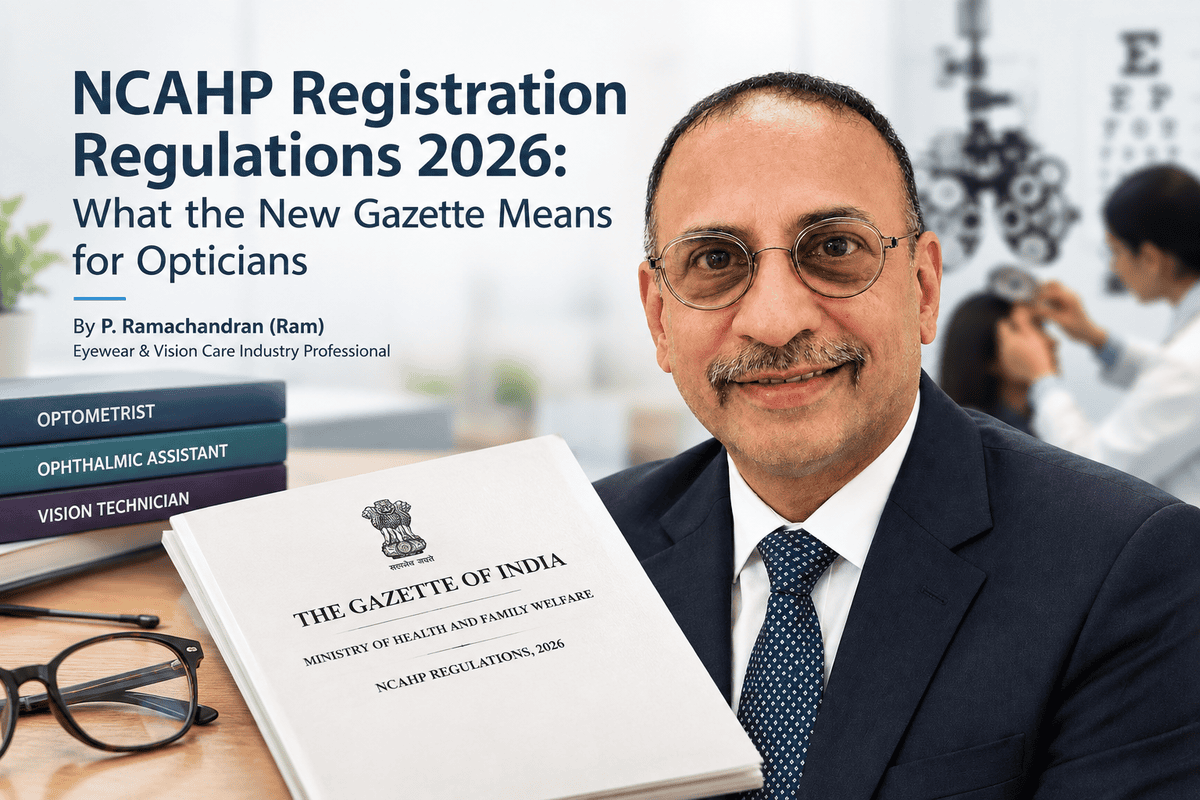
The Government of India has taken an important step towards formalising India’s allied and healthcare workforce with the notification of the Registration of Allied and Healthcare Professionals Regulations, 2026, under the National Commission for Allied and Healthcare Professions (NCAHP) Act, 2021.
The Gazette is dated 9 September 2026, and the Regulations come into force from the date of their publication.
For India’s optical community, this Gazette deserves particular attention—not because it suddenly regulates the business of selling spectacles, but because it brings much greater clarity to the qualifications and registration of professionals providing eye-care services.
Three Recognised Levels in Ophthalmic Sciences
Schedule I of the Regulations recognises Ophthalmic Sciences Professional as a category and, importantly for the optical sector, identifies three professions:
Optometrist, Ophthalmic Assistant and Vision Technician.
The new Bachelor of Optometry qualification is specified as a five-year programme—four years of study plus one year of internship. At the same time, the Schedule recognises several existing Optometry and Ophthalmic degree qualifications of a minimum three-year duration.
The framework should therefore not be interpreted to mean that holders of previously recognised degree qualifications suddenly cease to qualify for registration as Optometrists.
Equally significant for the optical trade is the treatment of diploma holders.
A two-year Diploma in Optometry with a minimum of 2,000 hours is expressly recognised, together with several other two-year qualifications such as Diploma in Refraction and Optometry, Diploma in Optics & Refraction and Diploma in Ophthalmic Assistant. These are placed under the professional designation Ophthalmic Assistant, subject to the prescribed conditions.
Importantly, such diplomas must be Government-approved or Government-recognised. Diploma courses conducted by non-government boards or bodies are specifically excluded.
The Gazette separately recognises the Vision Technician, based on a Government-approved or Government-recognised two-year Diploma in Vision Technician comprising at least 2,000 hours.
What Does This Mean for an Optician?
This is where the industry needs to clearly distinguish between optical retail and professional eye care.
An optician engaged in dispensing spectacles—helping customers select frames and lenses, taking dispensing measurements, fitting spectacles and providing after-sales service—should not automatically be equated with an Optometrist merely because the optical establishment also provides eye-testing facilities.
Conversely, owning or working in an optical shop does not by itself confer the professional status of an Optometrist.
Under the new Regulations, a person is entitled to practise a recognised allied or healthcare profession after obtaining the prescribed registration. Registration entitles the professional to provide services within the scope of practice of the recognised profession.
This distinction is likely to become increasingly important for optical establishments employing personnel to conduct refraction and eye examinations.
What About Experienced Opticians Already Doing Eye Tests?
Here, too, the Gazette contains an important transitional provision.
A person who was already offering services in a recognised category on or before the commencement of the NCAHP Act, but does not possess the prescribed recognised qualification, is required to obtain provisional registration.
Regulation 26 also provides a route to provisional registration, subject to compliance with the applicable requirements under Section 38 of the Act.
It would therefore be premature—and inaccurate—to interpret the September 2026 Gazette simply as saying that “Opticians can no longer conduct eye tests.”
The more important issue is the scope of practice attached to each recognised professional category.
Registration as an Optometrist, Ophthalmic Assistant or Vision Technician should not automatically be interpreted as meaning that all three categories have identical authority to independently examine patients, undertake refraction and prescribe spectacles. Clear scope-of-practice guidance will therefore be critical.
Registration Also Brings Continuing Professional Development
Another important change is that professional registration is not intended to be a one-time exercise.
Registration is valid for five years. For renewal, the professional is required to undertake a minimum of 15 hours of Continuous Professional Development (CPD) education every year and 75 hours during the five-year registration period, subject to the conditions specified in the Regulations.
This is a welcome development. Professional recognition should go together with continuous learning and upgrading of knowledge.
An Opportunity Rather Than a Threat
The optical industry should view this development positively.
India certainly needs stronger professional standards. At the same time, the country requires sufficient trained manpower to address the enormous burden of uncorrected refractive error and to make quality vision correction accessible across metros, towns, rural areas and underserved communities.
What the industry now needs from NCAHP is clear and practical guidance on some fundamental questions:
Who can conduct refraction? Who can independently prescribe spectacles? What activities can Ophthalmic Assistants and Vision Technicians perform independently? Which activities require supervision? And what transition or bridging pathway will be available to experienced existing practitioners?
The way forward should therefore not become a debate of Optometrist versus Optician. Both have important and complementary roles in India’s vision-care ecosystem.
The objective should be a transparent system in which qualification, competency, professional title and scope of practice are clearly defined, while experienced practitioners are provided a fair and practical transition pathway.
The Missing Piece: India Still Needs an Opticians Act
There is, however, a larger issue that the optical community should not lose sight of.
While the NCAHP framework addresses recognised healthcare professionals, India still needs a comprehensive discussion on the recognition and regulation of the optician and optical dispensing profession itself.
The time has therefore come for the industry to actively pursue an Opticians Act or an appropriate statutory framework for optical dispensing, clearly defining the role, qualifications, competencies, responsibilities and professional standards applicable to opticians.
Such a framework should be developed only after extensive consultation with all stakeholders—including opticians, optometrists, ophthalmologists, optical associations, educational institutions, industry representatives, NGOs and policymakers.
This requires unity within the optical community.
Optical associations across India should come together on a common platform and engage constructively with policymakers so that the voice of the dispensing optical profession is properly represented when future legislation and regulations are framed.
If implemented pragmatically, the September 2026 NCAHP Regulations can strengthen professional standards and public confidence without compromising India’s equally important objective of making quality vision correction accessible and affordable.
The Gazette should therefore be seen not as the end of the discussion, but as an important beginning—for professionalisation of eye care and, hopefully, for a long-overdue national conversation on the formal recognition of the optician in India.
The author is an eyewear and vision-care industry professional. The views expressed are personal.