
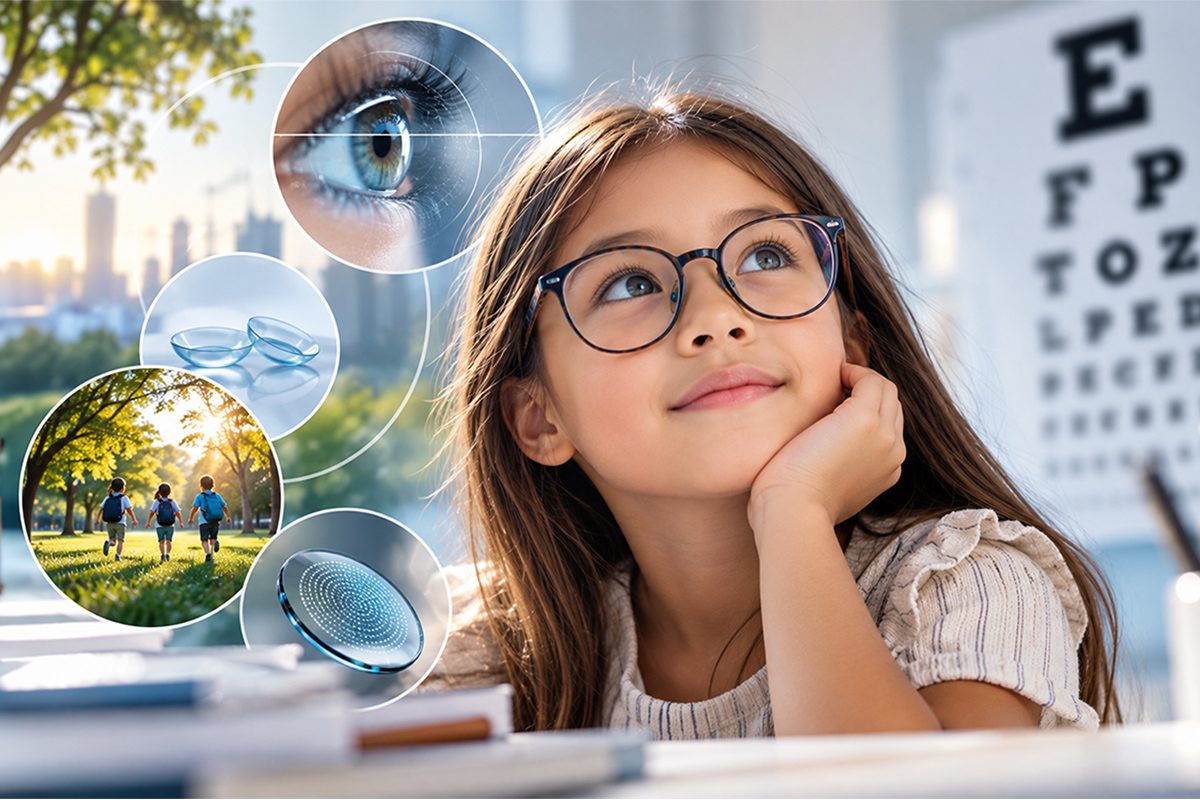

Myopia: Beyond The Prescription
With childhood myopia continuing to rise, the focus of eye care is shifting from correcting refractive error to managing progression
New evidence in 2026 is expanding the role of specialised spectacle lenses, atropine, contact lenses and emerging therapies, giving practitioners more options but also more decisions to make. For an optical professional, a changing prescription is familiar territory.
A child returns for an eye examination, the prescription has increased and a new pair of spectacles is dispensed. But what if the more important question is not simply how much the prescription has changed, but why it is changing and whether that progression
can be slowed?
That question is increasingly shaping modern myopia management. Myopia is no longer viewed simply as a refractive error to be corrected. Earlier onset and faster progression can increase the likelihood of developing high myopia, which is associated with a greater risk of serious ocular complications later in life. As a result, the emphasis is shifting towards early detection, monitoring and progression control. A review published in Current Ophthalmology Reports on 17 September 2026 highlights the expanding range of approaches, from atropine and contact lenses to specialised spectacle lenses, outdoor time and newer technologies. It also points to a growing emphasis on personalised treatment.
The Prescription Is Only The Starting Point
Traditional single vision spectacles remain effective for correcting blurred distance vision. What they do not do is actively slow myopia progression. Practitioners are increasingly looking at how a child’s prescription changes over time, alongside measurements such as axial length. This provides a broader picture than treating every prescription increase as an isolated event. For optical practices, the conversation can therefore move beyond whether a child needs a stronger prescription towards whether they may benefit from a myopia management strategy.
Spectacle Lenses Are Moving Forward
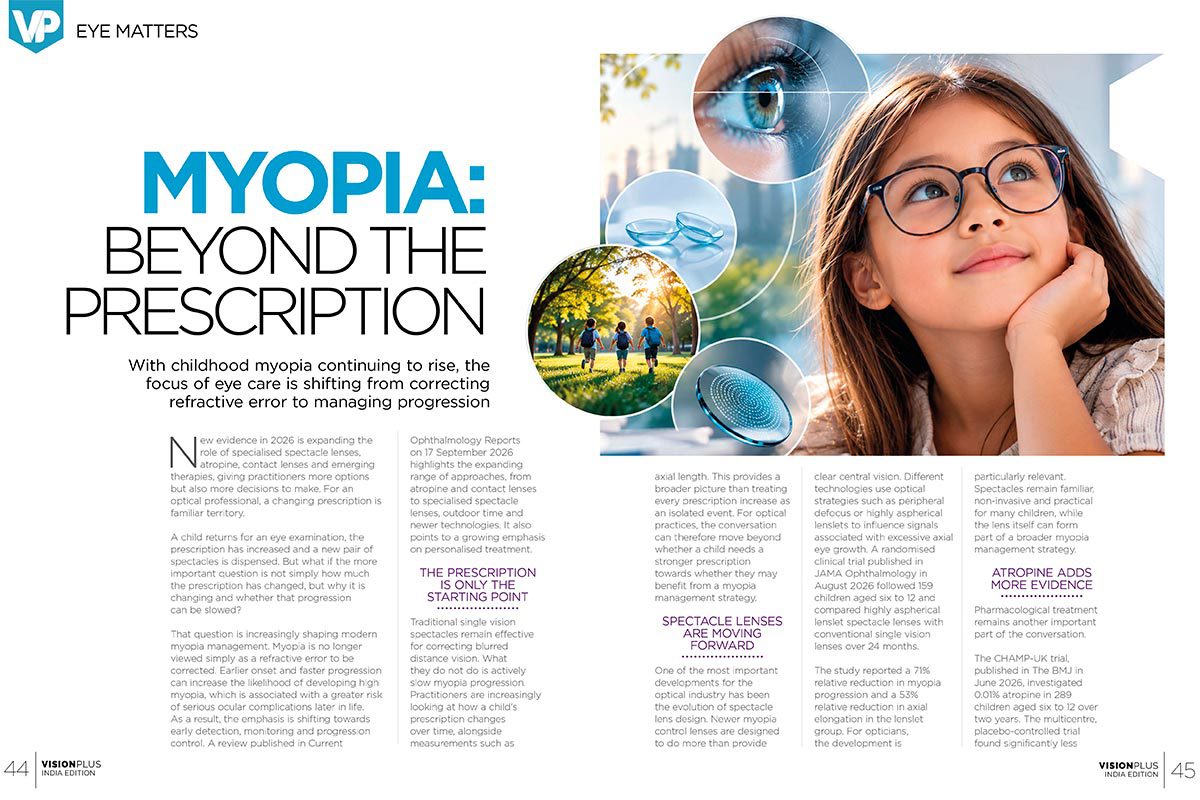
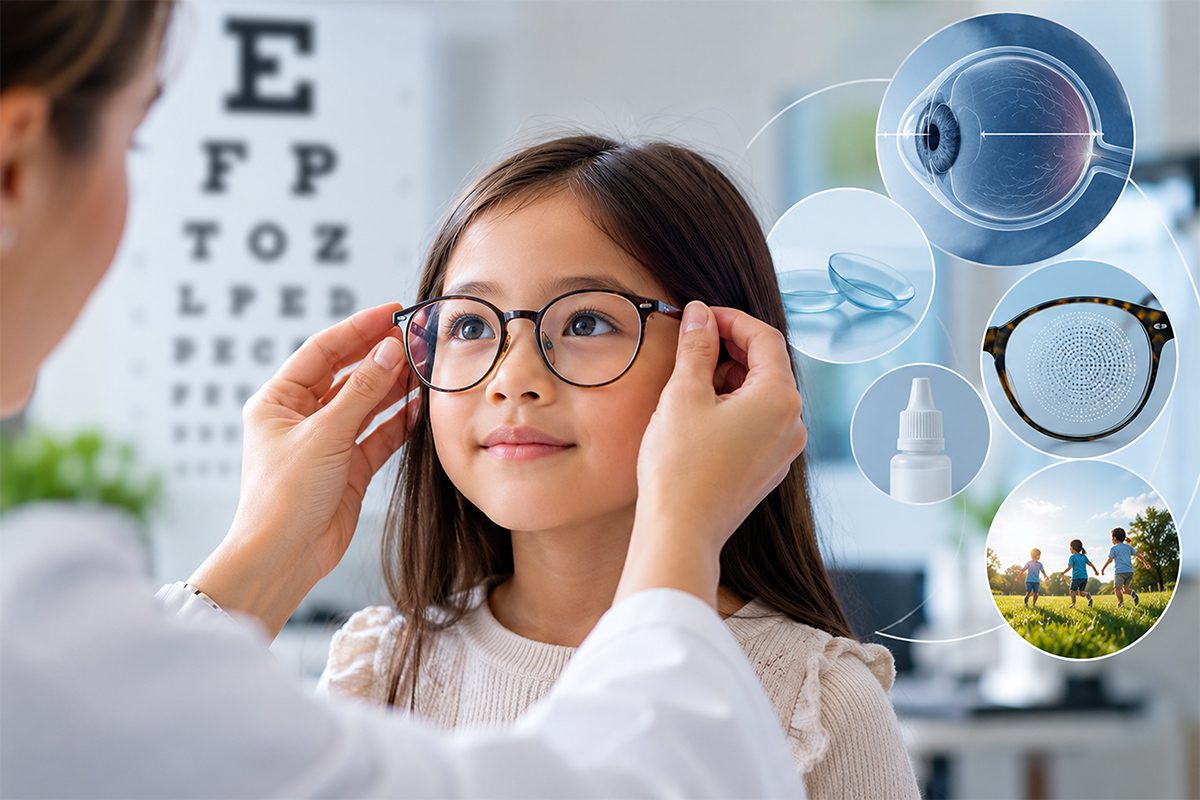
One of the most important developments for the optical industry has been the evolution of spectacle lens design. Newer myopia control lenses are designed to do more than provide clear central vision. Different technologies use optical strategies such as peripheral defocus or highly aspherical lenslets to influence signals associated with excessive axial eye growth. A randomised clinical trial published in JAMA Ophthalmology in August 2026 followed 159 children aged six to 12 and compared highly aspherical lenslet spectacle lenses with conventional single vision lenses over 24 months.
The study reported a 71% relative reduction in myopia progression and a 53% relative reduction in axial elongation in the lenslet group. For opticians,
the development is particularly relevant. Spectacles remain familiar, non-invasive and practical for many children, while the lens itself can form part of a broader myopia management strategy.
Atropine Adds More Evidence
Pharmacological treatment remains another important part of the conversation.
The CHAMP-UK trial, published in The BMJ in June 2026, investigated 0.01% atropine in 289 children aged six to 12 over two years. The multicentre, placebo-controlled trial found significantly less myopia progression and axial elongation in the atropine group than in the placebo group. The UK setting adds another perspective to the evidence base, much of which has historically come from Asian populations.
At the same time, atropine is not a universal solution. Age, progression rate, concentration, tolerability and individual circumstances all need to be considered.

Is Combination Treatment The Next Step?
As treatment options increase, researchers are also examining whether different approaches can work together. A study published on 25 September 2026 investigated 0.05% atropine as an additional treatment for children who continued to progress while wearing Defocus Incorporated Multiple Segments spectacle lenses. The findings add to emerging research around combining optical and pharmacological approaches.
However, the study was a retrospective matched cohort study rather than a randomised clinical trial, so its findings require appropriate interpretation. The research nevertheless reflects a broader shift towards adapting treatment according to individual progression and response.
A More Individual Approach
Perhaps the biggest change in myopia management is the move towards individualised care. There is no single intervention that will suit every child.
A seven-year-old with rapidly progressing myopia presents a different challenge from a 13-year-old whose prescription has remained relatively stable.
Age, refractive error, rate of progression, axial length, family history, lifestyle, treatment preferences and compliance can all influence clinical decisions.
For the optical professional, this means the role is changing too. Accurate refraction, appropriate correction and good dispensing remain fundamental, but they now sit within a longer conversation about monitoring and managing progression. The question is no longer simply, “What prescription does this child need?” It is increasingly, “How is this child’s myopia changing, and what can we do about it?” For the optical professional, the prescription is still where the conversation begins. Increasingly, however, it is no longer where the conversation ends.